
You deposit USDC into a DeFi vault showing 7% APY. Who is actually paying that yield? It is not created by the wallet. It does not appear because the token price rose. And the vault is not printing money.
In most lending products, the yield ultimately comes from borrowers paying interest. That should sound familiar. Banks have operated on the same basic economic relationship for centuries.
DeFi did not invent lending. It rebuilt lending using smart contracts, collateral, public data, and algorithms.
Follow One Dollar Through the System
Before comparing banks and DeFi, follow the money. A user deposits USDC into a vault. The vault allocates that USDC into selected lending markets. Borrowers post collateral and borrow the available USDC. Those borrowers pay interest. The lending protocol collects and accounts for that interest. The protocol, vault curator, or platform may deduct fees. The remaining return increases the value of the depositor’s vault shares.
The basic flow is:
Depositor → Vault → Lending market → Borrower → Interest → Depositor yield
This is the central mechanism behind many DeFi lending products.
The Traditional Banking Version
When a customer deposits money into a savings account, the bank does not leave it sitting idle. It uses part of its capital base to make loans to homeowners, businesses, and other borrowers. Borrowers pay interest on those loans. The bank keeps part of that interest and passes a smaller portion to depositors.
For example:
A depositor receives 4%.
A borrower pays 8%.
The 4% difference supports the bank’s operating costs, expected losses, compliance, liquidity needs, and profit.
The bank performs several jobs at once:
collecting deposits
evaluating borrowers
setting loan terms
managing repayments
maintaining liquidity
enforcing contracts or collateral
recording balances
reporting account activity.
The interest paid to the saver is therefore not arbitrary. It comes from a larger lending operation running behind the savings account.
The Fund-Management Version
Banks are not the only useful comparison. Traditional finance also has money-market funds, bond funds, private-credit funds, and loan funds. Instead of depositing money directly into a bank, investors buy shares in a managed portfolio.
A portfolio manager decides:
which assets or loans the fund may hold
how much capital to allocate to each position
what return the portfolio should target
when exposure should be increased or reduced
how much liquidity should remain available
This is the closest traditional-finance comparison to a DeFi vault. The investor does not personally choose every loan. The manager operates within a defined strategy, and the investor owns a share of the resulting portfolio.
Now Replace the Financial Infrastructure
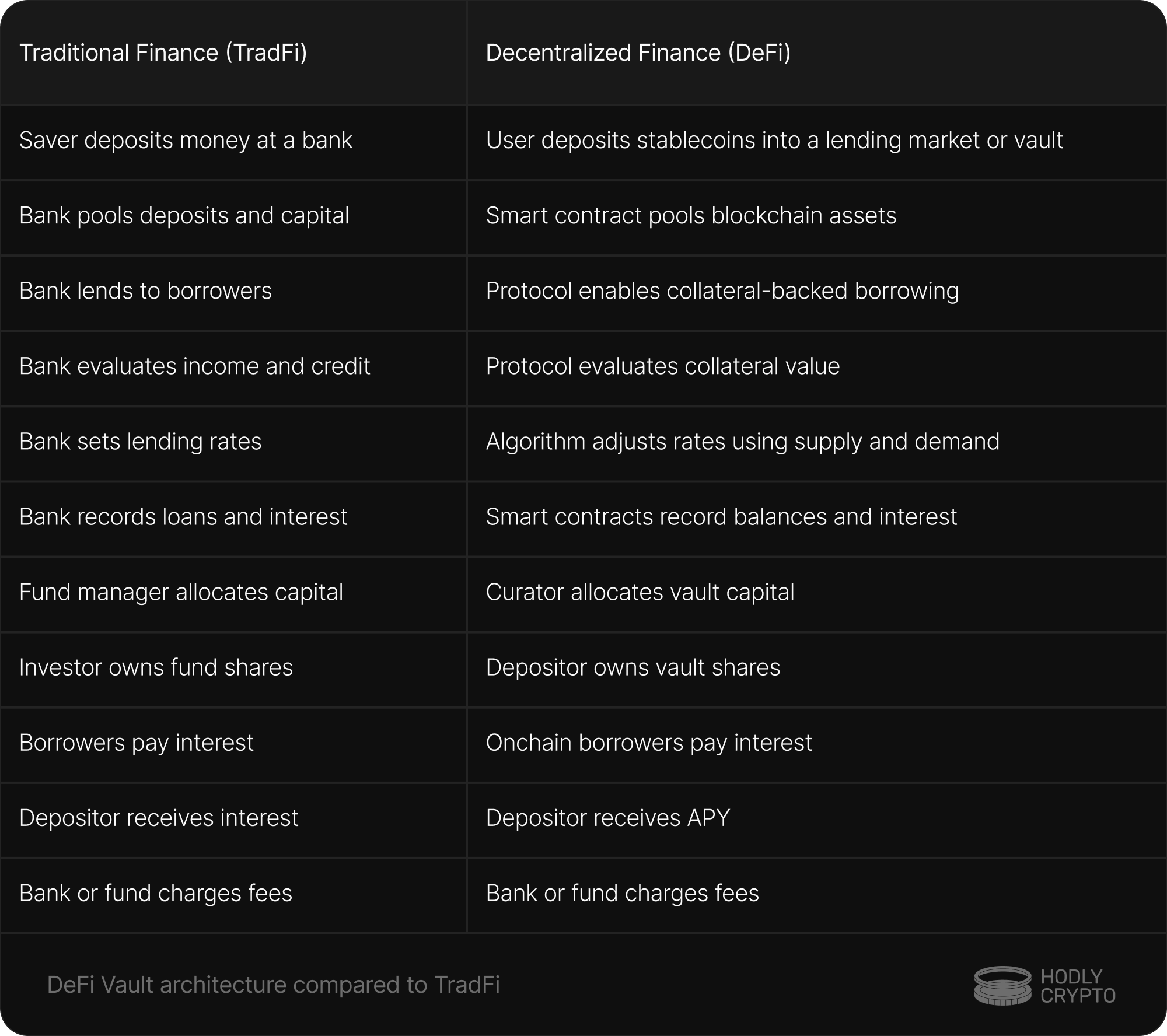
The roles remain recognizable in DeFi, but the operating system changes.
The bank account becomes a wallet
Instead of accessing money through a bank account, the user holds stablecoins or other assets in a blockchain wallet. The wallet becomes the user’s point of access to the financial system.
The bank’s internal ledger becomes a smart contract
Banks record balances in private databases. DeFi protocols record deposits, loans, collateral, interest, and withdrawals through smart contracts on a blockchain. The smart contract performs much of the accounting and settlement automatically.
The loan officer becomes collateral rules
A traditional lender may examine:
income
employment
credit history
business cash flow
existing debt
personal circumstances.
Most DeFi lending markets do not evaluate borrowers this way. Instead, borrowers usually provide assets worth more than the amount they borrow. A borrower might deposit $15,000 of ETH as collateral and borrow $10,000 of USDC. The protocol does not need to know the borrower’s name, salary, or credit score. It primarily needs to know the value of the collateral and whether it remains sufficient to support the loan.
The bank’s pricing team becomes an interest-rate algorithm
Banks decide lending and deposit rates through internal pricing models. DeFi lending protocols usually adjust rates based on market utilization. When borrowing demand is low and capital remains available, rates tend to fall. When most available capital has already been borrowed, rates rise to encourage:
additional deposits
discourage excessive borrowing
restore liquidity.
The rate is produced by rules connecting supply, demand, and available capital.
The fund manager becomes a curator
A DeFi vault may allocate deposits across multiple lending markets. The entity managing that allocation is commonly called a curator. The curator may:
approve eligible lending markets
select acceptable collateral types
set exposure limits
allocate capital between markets
retain liquidity for withdrawals
respond to changing borrowing demand
optimize the vault’s overall return.
The curator does not necessarily operate the underlying lending protocol. The protocol creates the lending markets. The curator decides how the vault should use them.
The Complete TradFi-to-DeFi Map
Where the APY Comes From
When a vault displays an APY, the number usually reflects the expected annualized return from its underlying positions.
For a lending vault, that return may be influenced by:
interest paid by borrowers
how much of the deposited capital is actively lent
the interest rates in each lending market
how the curator allocates capital
protocol incentives
management or performance fees
how frequently earnings are compounded
The APY is therefore an output of the underlying financial system. It is not the product itself. The product is the complete structure underneath it: capital, borrowers, collateral, interest rates, market allocation, fees, and settlement.
Where the Participants Make Money
Each participant has a different economic role.
Borrowers
Borrowers receive access to liquidity without necessarily selling their collateral. Someone holding ETH may borrow USDC while continuing to retain exposure to ETH. They pay interest for that flexibility.
Depositors
Depositors provide the capital borrowers use. In exchange, they receive a portion of the interest generated by the lending market.
Lending protocols
Protocols provide the smart contracts, accounting system, collateral rules, and market infrastructure. They may receive a portion of lending activity through protocol fees.
Curators
Curators research markets, define allocation rules, set limits, and manage the vault strategy. They may receive management or performance fees for operating the portfolio.
Consumer platforms
A platform may organize, explain, compare, route, or package these products for users. It may charge a deposit, subscription, access, or service fee depending on its model. This is similar to how traditional finance separates the roles of bank, fund manager, broker, platform, and financial adviser.
The protocol operates the lending market. The curator decides where the capital goes. But who helps the depositor understand what they are actually putting their money into?
That is the layer Hodly is building. See how DeFi yield products work, where their returns come from, and who manages them.