APY is only one part of a DeFi vault’s profile. Liquidity, asset exposure, yield sustainability, governance, market conditions, and track record also shape its risks.
The Hodly Yield Quality Score (YQS) evaluates these six dimensions and produces a score from 0 to 100. A weighted geometric mean limits the ability of strong dimensions to offset a material weakness. Safeguards may further constrain the score when severe risk conditions are observed.
A separate Reliability grade from A to E indicates how strongly the available data supports the assessment. Reliability measures evidence quality, not vault quality.
Applied to a snapshot of 56 vaults on Base, YQS shows that APY and observed quality are distinct.
Purpose1. What YQS showsYQS makes the risks and tradeoffs behind a vault’s APY more visible, consistent, and explainable.
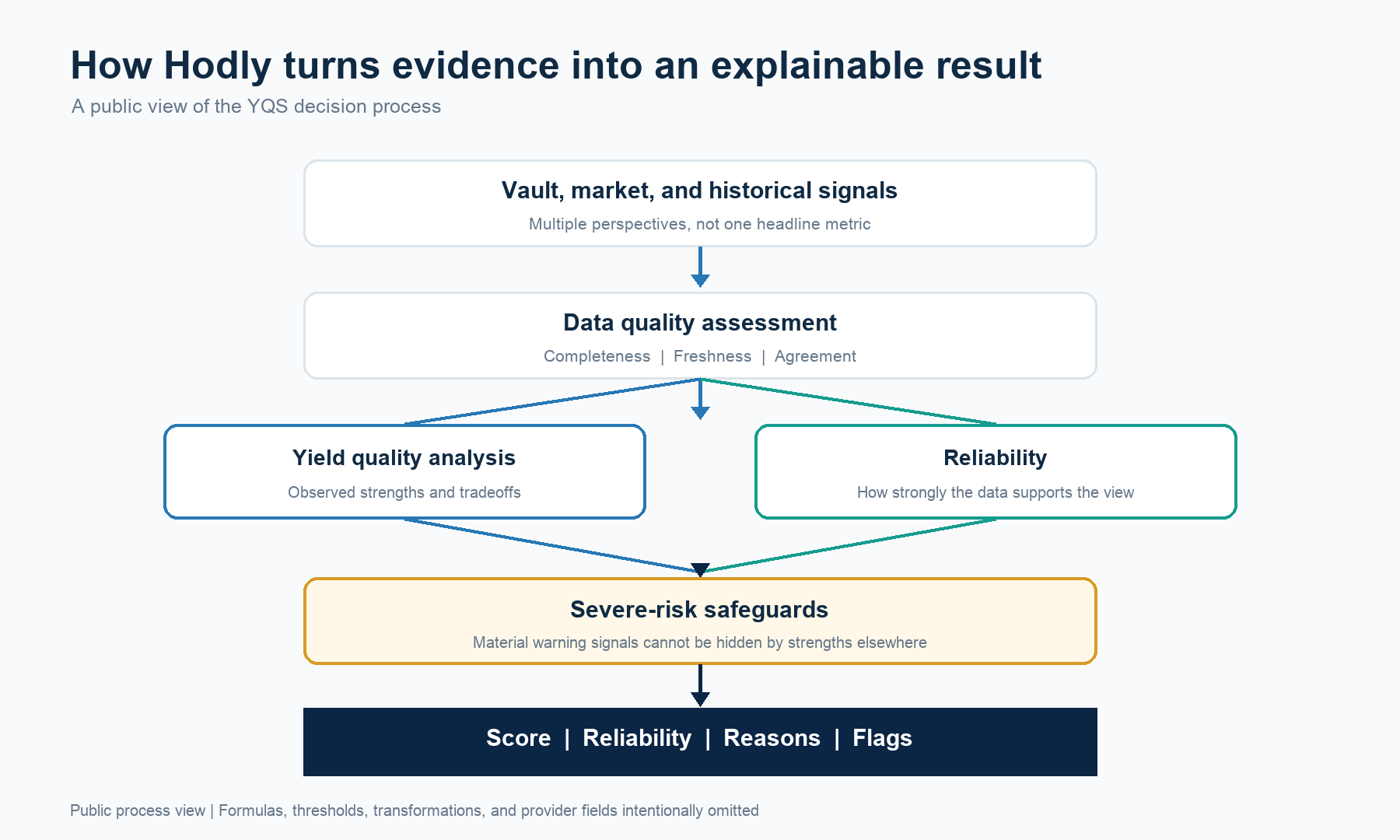
YQS gathers multiple classes of evidence, evaluates data quality, analyzes observed vault quality separately from Reliability, and applies safeguards when severe conditions are present.
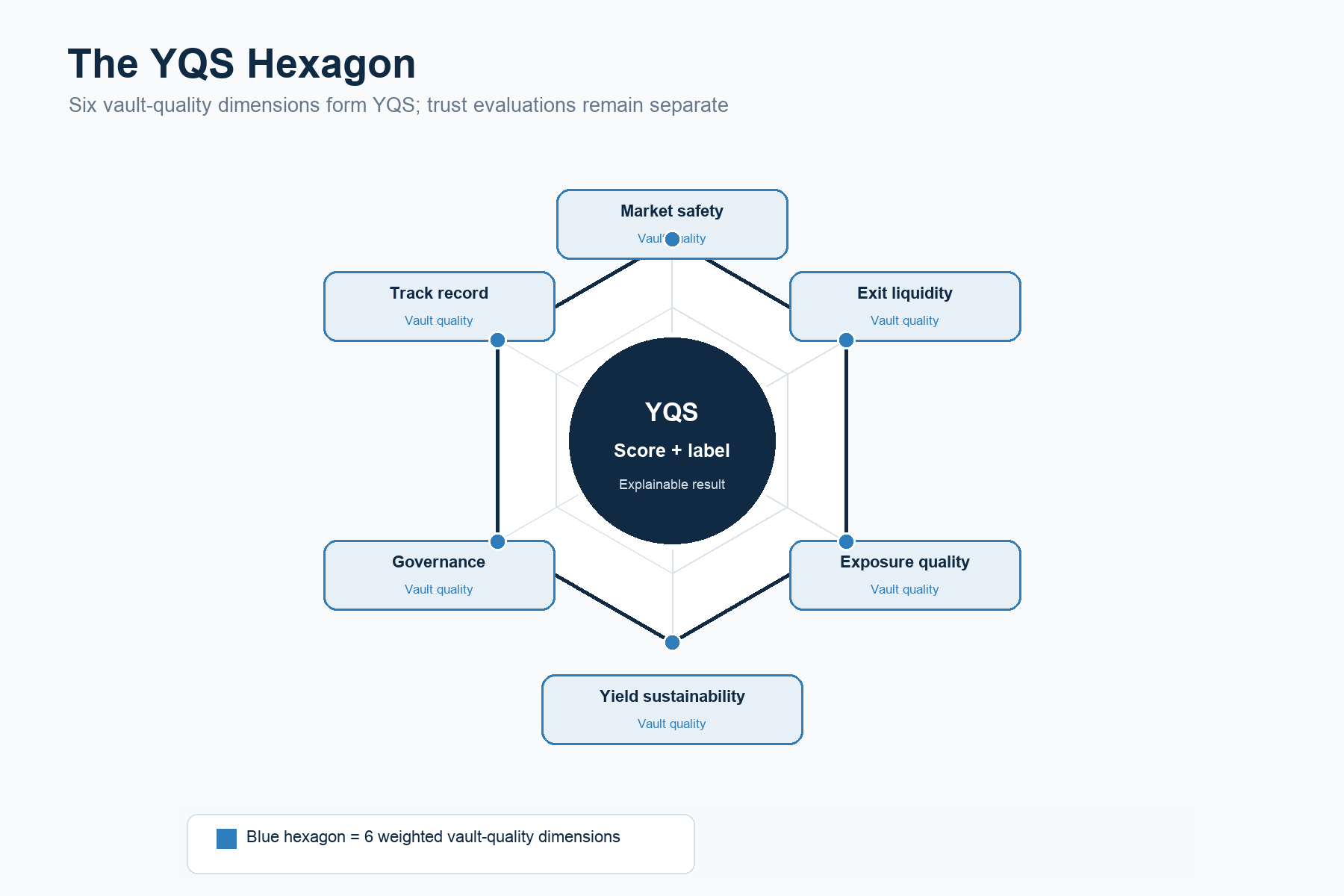
Read YQS in four steps. Each step answers a different part of the decision.
Start with APY. It shows the offered return, not the conditions behind it.
Read the YQS score and Vault Health label. They summarize the observed quality of the vault setup.
Check Reliability. It shows how strongly the available data supports the assessment.
Inspect the weakest dimensions, active safeguards, and deposit asset before deciding whether the tradeoff fits your objective.
High yield: Juno MXNB Prime
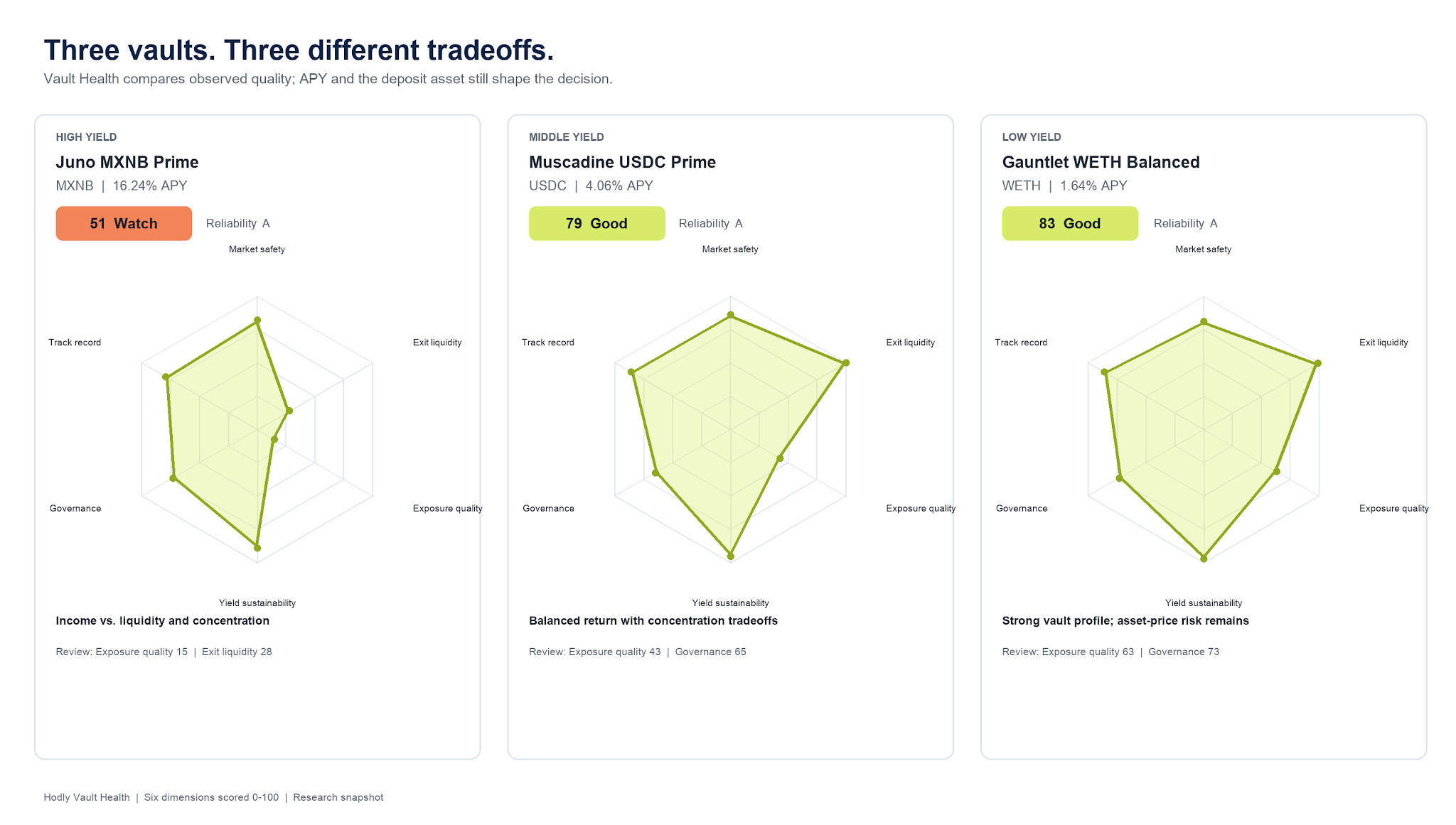
Juno offers a salient 16.24% current net APY but scores 51, Watch, with Reliability A. Market safety is comparatively strong, yet exit liquidity is 28/100 and exposure quality is 15/100. MXNB receives an UNKNOWN_YIELD_SOURCE disclosure: the uncertainty lowers the underlying confidence and can therefore reduce Reliability but does not automatically penalize yield sustainability, which is 89/100. YQS does not declare the return false; it shows which constraints and evidence gaps accompany the premium.
Middle yield: Muscadine USDC Prime
Muscadine offers approximately 4.06% current net APY and scores 79, Good, with Reliability A. Provider-reported reward-excluded APY is 4.07%, observed exit liquidity is strong, and the evidence is complete. Its principal limitations are modest scale, exposure quality of 43/100, and governance of 65/100. This is the paper’s balanced-yield case.
Low yield: Gauntlet WETH Balanced
Gauntlet WETH Balanced offers approximately 1.64% APY and scores 83, with Reliability A. The vault profile is strong, but a user seeking stable USD principal could still experience a large loss if ETH declines. This case proves a critical boundary: YQS evaluates the observed vault setup, not whether the deposit asset is suitable for the user’s objective
4. The six quality dimensions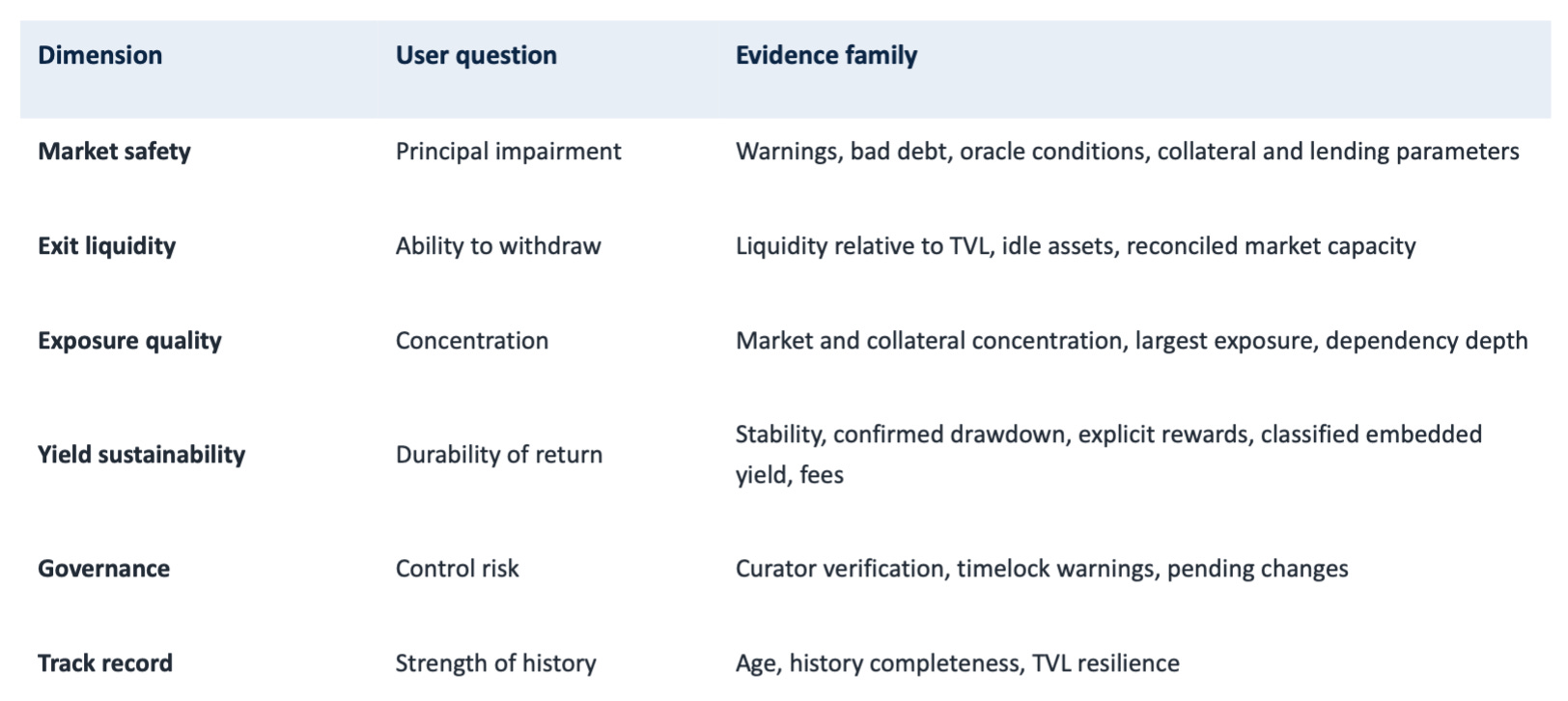
What each dimension does not prove
Market safety cannot detect unknown code vulnerabilities or future attacks.
Exit liquidity estimates current capacity; it cannot guarantee liquidity during a run.
Exposure quality measures observed concentration; shared economic dependencies may remain hidden.
Yield sustainability evaluates reported history and source transparency; it does not forecast APY.
Governance measures observable controls, not curator competence or intent.
Track record rewards evidence, not immunity from a new failure mode.

A simple average makes the fragile profile appear excellent because five strengths compensate for one severe weakness. The geometric design preserves the influence of the weak dimension. This is the mathematical expression of a user-facing principle: strong liquidity or yield should not erase evidence of capital impairment, concentration, or weak governance.
6. Reliability and safeguardsQuality and Reliability are reported as an ordered pair rather than multiplied together. A high-quality observation with Reliability D or E is uncertain, not automatically low quality. Conversely, a low-quality result with Reliability A represents well-supported weakness.
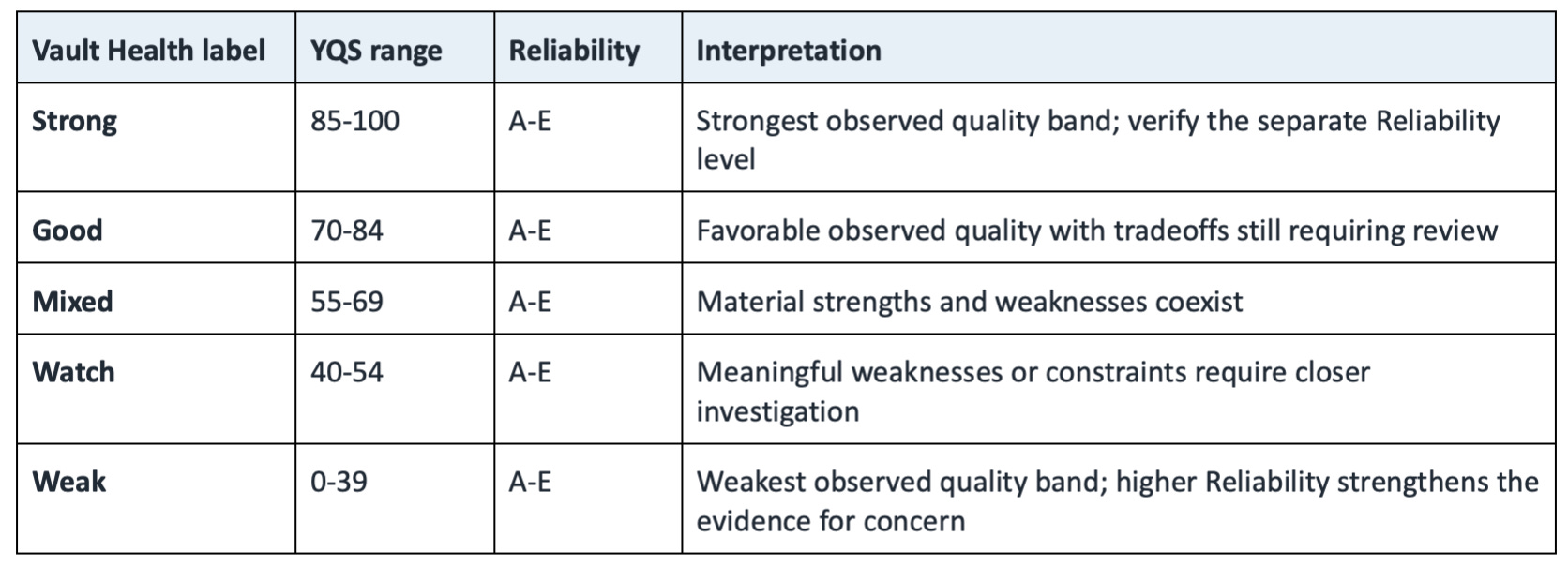
Reliability translates backend confidence into five reader-facing levels: A (85-100), B (70-84), C (55-69), D (40-54), and E (0-39). Confidence reflects completeness, reconciliation, elapsed historical coverage, observed-day density, and recency. Because freshness is measured from the latest timestamp, old or interrupted history cannot receive Reliability A merely because a provider returns many points.
Q_final = minimum of Q_raw and every active safeguard ceiling
This construction proves that the final result cannot exceed the raw score or any active ceiling. Safeguards treat severe observed conditions as constraints rather than ordinary point deductions. Under methodology 2.1.0, nested-market safeguards also require material active exposure; smaller warning-bearing allocations remain disclosed as evidence rather than becoming automatic ceilings. Public research should describe these principles while exact production mappings and thresholds remain controlled policy documentation.
7. Technical validationThe following methodology and mathematical properties make the public design testable.
YQS first checks the vault’s historical data. YQS then considers the vault’s actual exposure. Finally, YQS reviews where the yield comes from.
Normalized components and weights
Let the six normalized quality components be:
x = (M, L, E, Y, G, T), where each x_i lies on a 0-100 scale
Let each weight be positive and let the weights sum to one. The public aggregation is a weighted geometric mean:
Q_raw = product over i of max(x_i, epsilon) raised to w_i
Property 1: boundedness
If every component lies between 0 and 100, the weighted geometric mean also lies between 0 and 100. The aggregate therefore remains interpretable on the component scale.
Property 2: monotonicity
dQ_raw / dx_j = w_j times Q_raw / x_j, which is positive
Holding every other input constant, improving one component cannot reduce the raw score. This property is directly testable and is covered by monotonic contract tests.
Property 3: non-compensation
Q_raw is less than or equal to the weighted arithmetic mean
The weighted arithmetic-geometric mean inequality proves that imbalance is penalized. Equality occurs only when all component values are equal. A vault cannot obtain the same benefit from averaging when one dimension is materially weaker.
8. Limits and traditional parallels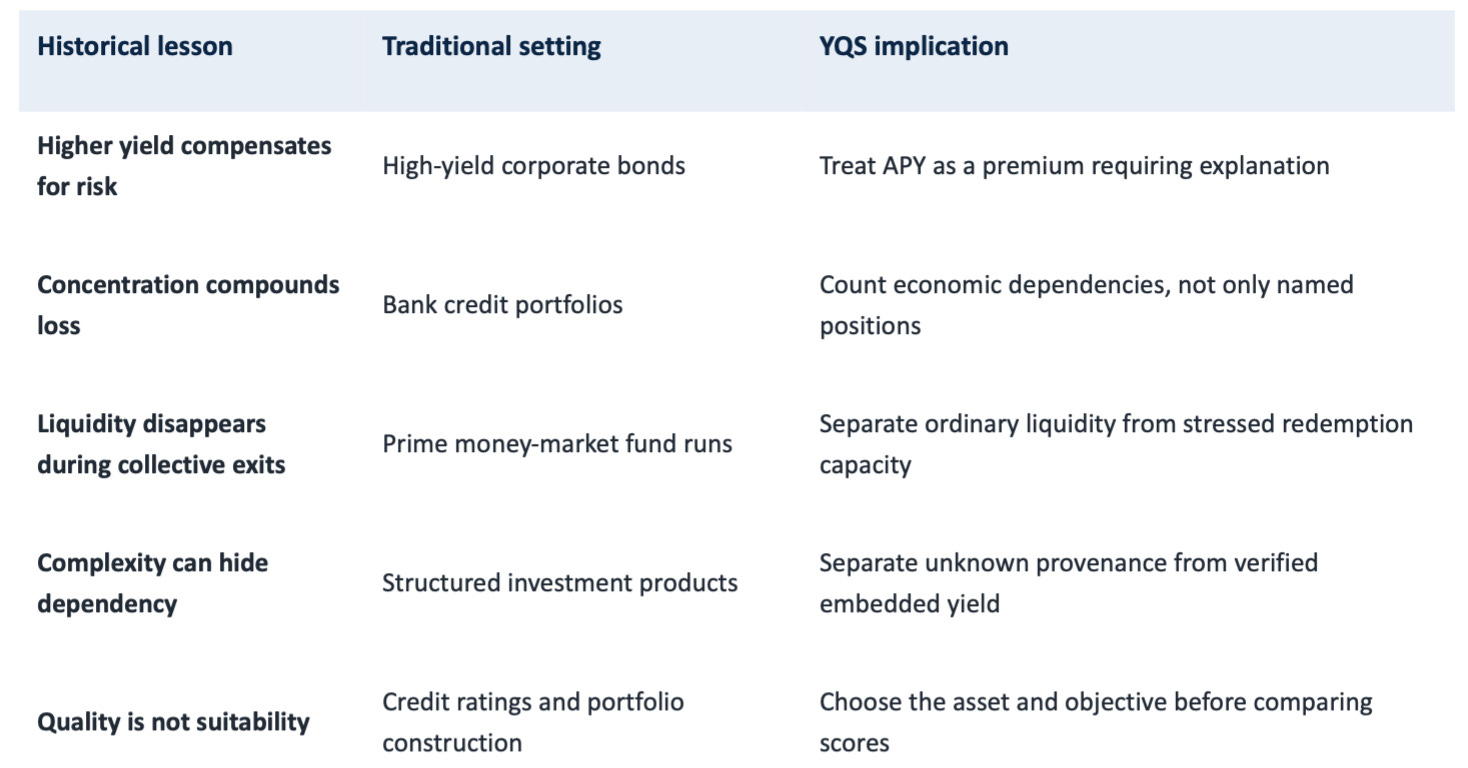
These are explanatory parallels, not claims of equivalence. DeFi vaults differ in custody, transparency, governance, composability, and technical risk. The historical lesson is methodological: financial systems repeatedly fail when a simple return or stability label receives more attention than concentration, liquidity, and dependency structure.
9. ConclusionAPY tells users what a vault currently offers. It does not explain the liquidity, concentration, yield sustainability, governance, track record, or evidence quality behind that return.
APY shows the return. YQS shows the conditions behind it.
YQS brings six observed quality dimensions into one score while reporting Reliability and safeguards separately. Across the 56-vault snapshot, APY and vault quality did not move together. High yield could come with material tradeoffs, while lower yield could accompany a stronger overall profile.
YQS is not a safety guarantee or a forecast of future returns. Its purpose is practical: show what supports a vault’s yield, where the material weaknesses are, and how strongly the available evidence supports the assessment. It gives users more context for comparison before they commit capital.
Sources and notesHodly YQS methodology, implemented scorer specification and production correction
Disclosure: YQS is a comparison framework, YQS not financial advice, a credit rating, a probability of loss, a forecast, or a guarantee of vault safety, liquidity, or future return.