Two USDC vaults sit next to each other. One pays 5%. The other pays 9%. Both are onchain. Both are overcollateralized. Both appear simple: deposit USDC, receive vault shares, and begin earning yield.
So why does one pay almost twice as much?
The answer is not only the smart contract. Someone decided which lending markets the vault could enter. Someone approved the collateral, set exposure limits, evaluated liquidity, and determined whether the higher return justified the additional risk.
That person—or organization—is the curator.
In traditional finance, the closest comparison may be a private credit portfolio manager. Both allocate other people’s capital across lending opportunities. Both establish portfolio limits, monitor risks, and attempt to produce attractive risk-adjusted returns.
But there is one important difference:
A private credit manager underwrites the borrower. A DeFi curator underwrites the liquidation system.
That difference explains where DeFi lending yield comes from, why two vaults holding the same asset can produce very different results, and why evaluating the curator may be just as important as evaluating the APY.
How private credit turns capital into yield
Private credit refers broadly to loans made by nonbank investment vehicles to private companies. These loans are usually negotiated directly rather than traded publicly like bonds.
A simplified private credit structure looks like this:
Investor → private credit fund → credit manager → borrower → interest returned to the fund
The manager receives capital from investors and deploys it across selected loans.
Before approving a loan, the manager may examine:
The borrower’s revenue and cash flow
Its ability to make interest payments
Existing debt
Collateral value
Loan-to-value ratios
Industry conditions
Management quality
Legal protections
Expected recovery after default
The manager is not simply looking for the loan with the highest interest rate. A company offering to pay 15% may be more attractive than one offering 8%, but the higher rate may exist because repayment is less certain, collateral is weaker, or recovery could be difficult. The objective is to generate an attractive return after accounting for losses, expenses, fees, and illiquidity.
A simplified version looks like this:
Risk-adjusted return = interest and fees − credit losses − operating costs − manager fees
This is why the manager matters. Investors are not merely purchasing a collection of loans. They are relying on a decision-making process: which loans enter the portfolio, how large each position becomes, and what happens when a borrower begins to fail.
According to the Federal Reserve’s overview of private credit, many direct-lending loans are senior, secured, and floating-rate. These protections may reduce risk, but they do not eliminate it. The manager must still determine whether the borrower, collateral, and legal structure are sufficient to protect investor capital.
How a curated DeFi vault works
A curated DeFi lending vault follows a similar capital flow:
Capital provider → onchain vault → curator-selected lending markets → borrowers → interest returned to the vault
The user deposits an asset such as USDC into a vault. The vault allocates that capital across one or more lending markets. Borrowers pay interest, and the resulting income flows back to the vault after applicable fees. The curator defines the strategy behind those allocations.
Depending on the protocol and vault design, the curator may decide:
Which lending markets are eligible
Which collateral assets are acceptable
How much capital can enter each market
How concentrated the vault may become
Which oracles and liquidation systems are acceptable
How much withdrawal liquidity should remain available
When the vault should increase or reduce exposure
Which parties may execute allocation changes
How management or performance fees are structured
Within Morpho Vault V2, for example, curators can define vault strategies, approve allocation routes, establish exposure caps, appoint operational roles, and configure certain controls.
The smart contract executes the rules, but it does not independently decide what risks are worth taking. That remains a portfolio-management decision.
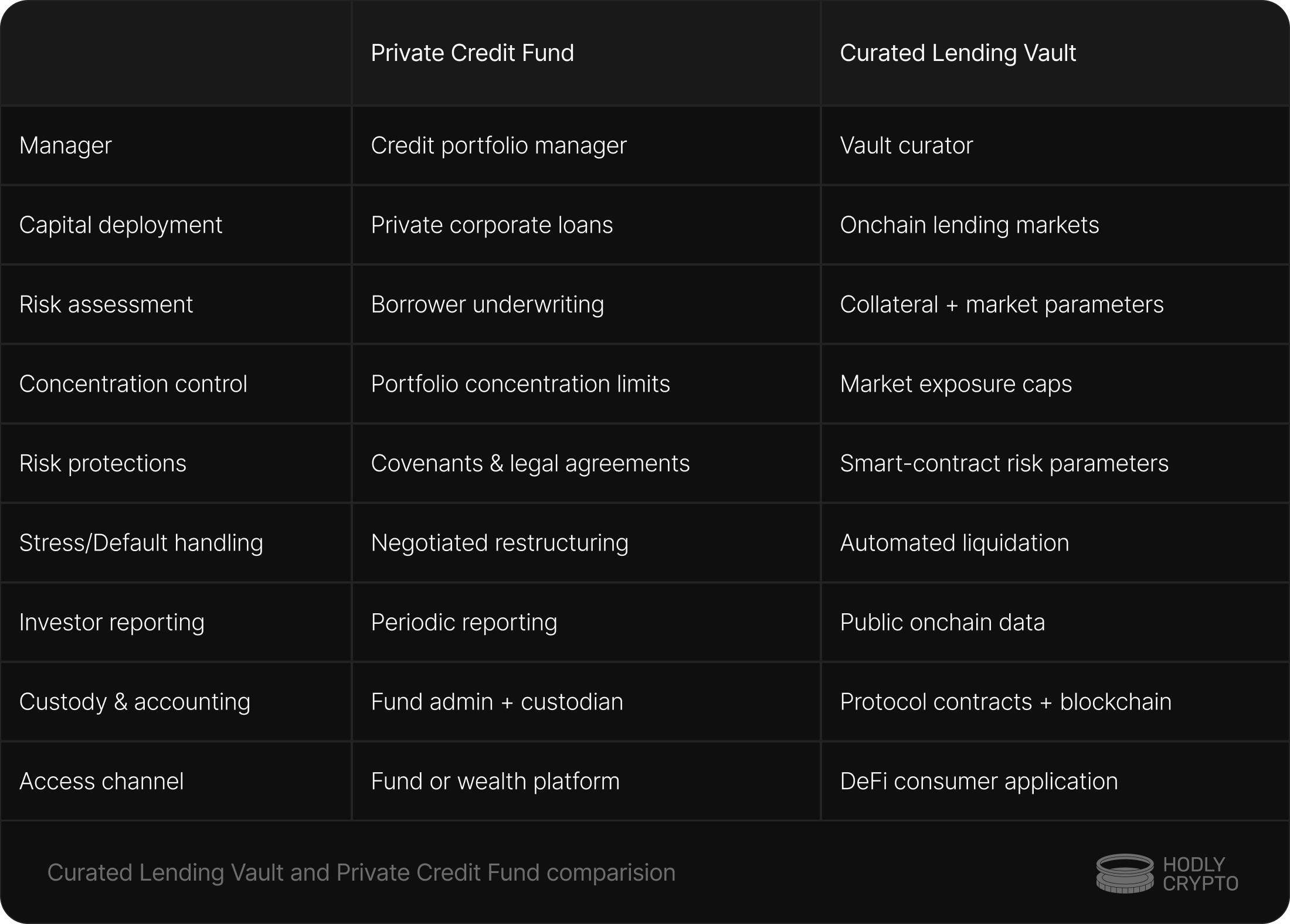
The central similarity is capital allocation under uncertainty.
Both managers must decide:
Which risks to accept
How large each position should become
Whether the expected income compensates for the downside
How much liquidity to preserve
How the portfolio may behave during stress
The major difference lies in what is being underwritten.
The private credit manager underwrites repayment
In traditional private credit, the analysis begins with the borrower. Imagine a private company seeking a $10 million loan.
The manager asks:
Does the company generate enough cash to pay interest?
How stable is its business?
What existing debt ranks ahead of this loan?
What collateral secures the loan?
What legal rights will lenders have?
Can the loan be restructured if performance deteriorates?
How much capital could be recovered after default?
The borrower’s identity, business quality, management, financial statements, and legal obligations all matter. The manager’s first line of defense is the borrower’s ability to repay.
If repayment fails, the manager may negotiate new terms, enforce covenants, take control of collateral, restructure the loan, or participate in a bankruptcy process.
The DeFi curator underwrites liquidation
Overcollateralized DeFi lending works differently.
The borrower may not provide a legal name, credit report, income statement, or personal guarantee. The protocol may not need to know whether the borrower operates a profitable company or has a stable salary.
Instead, the borrower locks assets in a smart contract. Imagine a borrower who deposits $150 of collateral and borrows $100. At the beginning, the loan appears well protected. The collateral is worth substantially more than the outstanding debt.
The curator, however, must ask a different set of questions:
How quickly can the collateral fall?
How accurately will the oracle update?
How much liquidity exists for selling the collateral?
Will liquidators act quickly enough?
How much slippage will occur?
Could network congestion delay execution?
Are several collateral assets dependent on the same protocol, bridge, issuer, or liquidity venue?
Suppose the collateral falls from $150 to $115. The loan may still be recoverable, but liquidation is becoming urgent. If the collateral then falls to $105, the remaining buffer is small. Liquidation incentives, trading slippage, transaction costs, and delayed execution may reduce the amount recovered below the $100 debt.
The critical question is no longer whether the borrower intends to repay. It is whether the system can sell the collateral before its recoverable value becomes insufficient.
Traditional credit depends primarily on the borrower’s ability to repay. Overcollateralized DeFi lending depends primarily on the system’s ability to liquidate when the borrower does not.
This is what the curator is really underwriting.
Collateral is only useful if it can be sold
The word “collateralized” can sound reassuring. But collateral protects lenders only when three conditions remain true:
It retains enough value.
It remains accessible.
It can be sold quickly enough.
Traditional secured lenders face this problem with real estate, equipment, receivables, and company assets. A factory may have a high estimated value, but recovering that value can take months or years.
DeFi compresses the same problem into minutes.
A token may appear highly liquid under normal conditions, but market depth can disappear during a sharp selloff. A stablecoin may lose its peg. A bridged asset may depend on infrastructure outside the lending protocol. A liquid staking token may inherit risks from both its issuer and its underlying asset.
The curator must therefore evaluate more than the collateral’s current market capitalization.
The relevant question is:
How much of this collateral could realistically be sold during the exact market conditions in which liquidation becomes necessary?
Why one vault pays more than another
A vault’s APY is the output of underlying market conditions and curator decisions.
A higher APY may exist because:
Borrowing demand is stronger
Market utilization is higher
Available liquidity is lower
The collateral is more volatile
The market is newer or less established
Token incentives are subsidizing the rate
The vault is more concentrated
The curator accepts exposures that conservative vaults reject
Leverage or looping increases the effective return
Consider two USDC vaults.
Vault A
Allocates mainly to established ETH-backed lending markets
Maintains larger liquidity buffers
Uses conservative exposure caps
Earns approximately 5%
Vault B
Allocates to newer markets
Accepts more volatile collateral
Maintains less idle liquidity
Uses temporary token incentives
Earns approximately 9%
Vault B may be the better opportunity.
But the extra 4% is not appearing from nowhere. It exists because borrowers, protocols, or incentive programs are paying capital providers to accept additional conditions.
Yield is not merely a reward. It is a price paid for accepting a particular set of risks, constraints, and dependencies.
The most useful question is therefore not:
Which vault pays the most?
It is:
Why does this vault pay more, and what must remain true for that return to continue?
So, is the curator the new private credit manager?
Functionally, there is a strong resemblance.
Both private credit managers and DeFi curators:
Allocate other people’s capital
Select acceptable lending opportunities
Establish portfolio limits
Monitor concentration
Manage liquidity
Evaluate downside scenarios
Attempt to produce attractive risk-adjusted returns
But the mechanisms are different.
A private credit manager relies on borrower underwriting, negotiated contracts, covenants, legal enforcement, and restructuring.
A DeFi curator relies on collateral selection, exposure caps, market liquidity, smart contracts, price oracles, and automated liquidation.
The private credit manager asks:
Can the borrower repay?
The DeFi curator asks:
Can the system recover the loan when the borrower does not?
That makes “private credit manager” a useful analogy, but not an exact definition. The curator is a new type of portfolio decision-maker built for programmable lending markets.
Making the strategy behind the APY easier to see
Direct access to curated DeFi lending strategies is valuable, but direct access does not automatically make those strategies easy to evaluate.
HodlyCrypto helps users examine the strategy behind the displayed return.
Before connecting a wallet, users can compare information such as:
Curator identity
Vault APY
Available liquidity
Collateral exposure
Portfolio concentration
Vault health
Meaningful changes in the underlying strategy
Hodly does not replace the curator, eliminate DeFi risk, or guarantee yield.
Its role is to make raw onchain portfolio information easier to understand before and after a user enters a vault.
Because the APY is only the output.
The real product is the strategy used to create it.
This article is for educational purposes only and does not constitute financial, investment, legal, or tax advice. DeFi lending involves smart-contract, collateral, liquidity, oracle, market, and loss-of-principal risks. APY is variable and is not guaranteed.